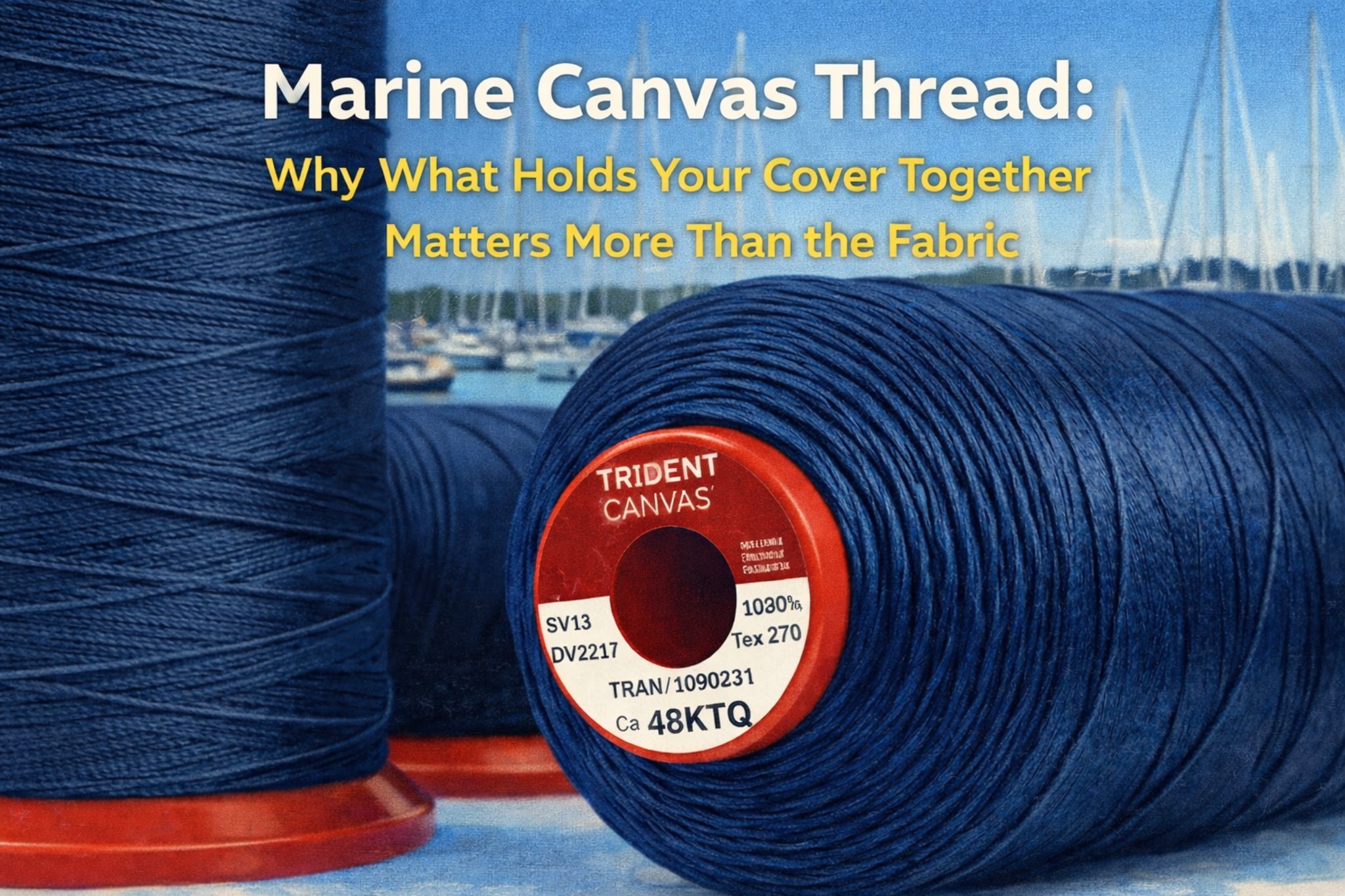
Here’s something most boat owners never think about until it’s too late: the thread holding your sprayhood, cockpit covers and enclosures together will almost certainly fail before the fabric does. You can have the best acrylic canvas on the market, but if the seams are stitched with the wrong thread, you’ll be paying for re-stitching — or worse, a completely new cover — years before you should need to.
This is a quick guide to the main types of marine sewing thread, what they’re good for, and what to look out for when you’re commissioning new canvas work or checking the condition of existing covers.
Polyester (Dacron): The Industry Standard
The most common thread you’ll find in marine canvas work is polyester, often referred to by the trade name Dacron. It’s used by the majority of canvas shops in the UK and worldwide, and with good reason: it’s strong, widely available in a huge range of colours, relatively UV-resistant and affordable.
Common brands include HH Hayne & Hoole, Bex, A&E (American & Efird), and A-Tech. Thread sizes are measured by a “Tex” numbering system — Tex 92 (also called V-92) is the most common weight for standard marine canvas work, while Tex 138 (V-138) is heavier and used for work that takes more stress, such as sail covers and large sprayhoods.
The honest truth about polyester thread: it’s good, but it has a shelf life in the sun. UV radiation gradually breaks down the fibres, and in a typical UK climate you can expect between five and eight years before seams start to weaken and fail. In hotter, sunnier climates like the Mediterranean, that drops to three to five years. When polyester thread degrades, it doesn’t give you much warning — seams can look fine from the outside but pull apart with minimal force. If your covers are five years old and you can see the thread looking slightly fuzzy or faded, it’s time to start thinking about re-stitching.
If your canvas maker uses polyester, make sure they’re using a proper marine-grade thread with UV inhibitors — not a generic industrial polyester from a general sewing supplier. There is a significant difference in outdoor longevity. Also, heavier is generally better: if the machine can handle Tex 138 rather than Tex 92, go with the heavier thread. It costs marginally more and lasts noticeably longer.
Nylon: The One to Avoid for Exterior Work
Nylon thread is widely used in auto trim shops and furniture upholstery, and it’s an excellent thread for those applications — strong, elastic and durable indoors. But it has a fatal weakness outdoors: it degrades rapidly under UV exposure. In direct sunlight, nylon can lose most of its strength within two to three years.
The problem is that many general upholstery businesses and auto trim shops occasionally take on marine canvas work without switching their thread. They’re not being dishonest — they simply don’t realise that nylon, which works perfectly indoors, falls apart when exposed to sun and salt. If you’re having canvas work done by anyone who isn’t a specialist marine canvas maker, it’s worth asking explicitly what thread they’re using. Nylon should never be used for any exterior marine application. Full stop.
PTFE Thread: The Premium Option
If you want thread that will genuinely outlast the fabric it’s sewn into, you need PTFE — polytetrafluoroethylene, the same material as Teflon. PTFE thread is essentially immune to UV degradation, chemical exposure, salt water, mildew and temperature extremes. It doesn’t rot, it doesn’t fade and it doesn’t weaken in the sun. The major manufacturers back this up with lifetime warranties.
The three main PTFE threads on the market are:
Gore Tenara — the original and most established PTFE thread, made from expanded PTFE (ePTFE) fibre by W.L. Gore & Associates (the same company behind Gore-Tex). Tenara has been on the market for over 30 years and has a proven track record in marine, architectural and awning applications. It’s available in several styles: the original Tenara, TR (lubricated for high-speed sewing) and HTR (a 3-ply heavy-duty version). Available in a limited range of colours plus a popular “clear” option that blends with most fabrics.
Solarfix — a newer PTFE thread that has become increasingly popular with marine canvas makers, particularly in the US. Solarfix 2000 is the main product, available in a wider range of colours than Tenara and often praised for being slightly easier to sew with on standard industrial machines. Like Tenara, it carries a lifetime warranty against UV degradation.
Aruvo — manufactured by Fil-Tec, another PTFE thread with similar performance characteristics. Aruvo is noted for its lower elongation and twisted yarn construction, which some sewers find gives better stitch consistency. Pre-wound bobbins are available, which is a useful time-saver in a busy workshop.
The trade-off with PTFE thread is cost and handling. A one-pound spool of PTFE thread costs roughly £150–£180, compared to perhaps £15–£25 for the equivalent in polyester. It’s also more demanding to sew with — PTFE is slicker than polyester, which means it can slip in the tension discs and requires careful machine setup. The thread doesn’t expand into needle holes the way polyester does, which means it doesn’t self-seal as effectively against water migration through stitch lines. On a well-made cover with properly sized needles, this isn’t usually an issue, but it’s worth knowing.
Does It Actually Matter?
In a word: yes. Consider the economics. A typical sprayhood for a 30-foot sailing yacht might cost £1,500–£3,000 depending on the boat and specification. The difference in thread cost between polyester and PTFE on that job is perhaps £30–£50. But the difference in lifespan can be significant: the polyester-stitched sprayhood might need re-stitching after six or seven years (and re-stitching a sprayhood is a full day’s work, typically £300–£500), while the PTFE-stitched version will outlast the fabric itself.
For covers that live permanently outdoors and take serious UV exposure — sprayhoods, biminis, cockpit enclosures and sail covers — PTFE thread is worth every penny. For covers that are used occasionally and stored when not in use, good-quality marine polyester is perfectly adequate.
What to Ask Your Canvas Maker
When commissioning new marine canvas work, these are the questions worth asking about thread:
What type of thread are you using? The answer should be either marine-grade polyester (with UV inhibitors) or PTFE. If the answer is “just standard thread” or the maker can’t tell you the specific product, that’s a concern.
What weight/size? Tex 92 minimum for standard work, Tex 138 or equivalent for heavier applications. Heavier thread lasts longer.
Is PTFE available as an upgrade? A good canvas maker will offer this as an option and explain the cost difference honestly. If they don’t mention it, ask.
What needle size are you using? This matters more than people realise. An oversized needle creates holes larger than the thread can fill, leading to water ingress through the stitch line. The needle should be matched to the thread weight — a good canvas maker will know this instinctively.
Thread isn’t glamorous. Nobody looks at a new sprayhood and says, “lovely thread choice.” But it’s the single factor most likely to determine how long your investment lasts. Getting it right at the outset saves money, hassle and disappointment further down the line.
Sources: W.L. Gore & Associates (gore.com), Sailrite, Trivantage, Herculite Products, Cover Girl Marine Canvas & Upholstery, Marine Fabricator magazine. Pricing indicative based on 2025/26 UK trade supply costs.
Leave a Reply