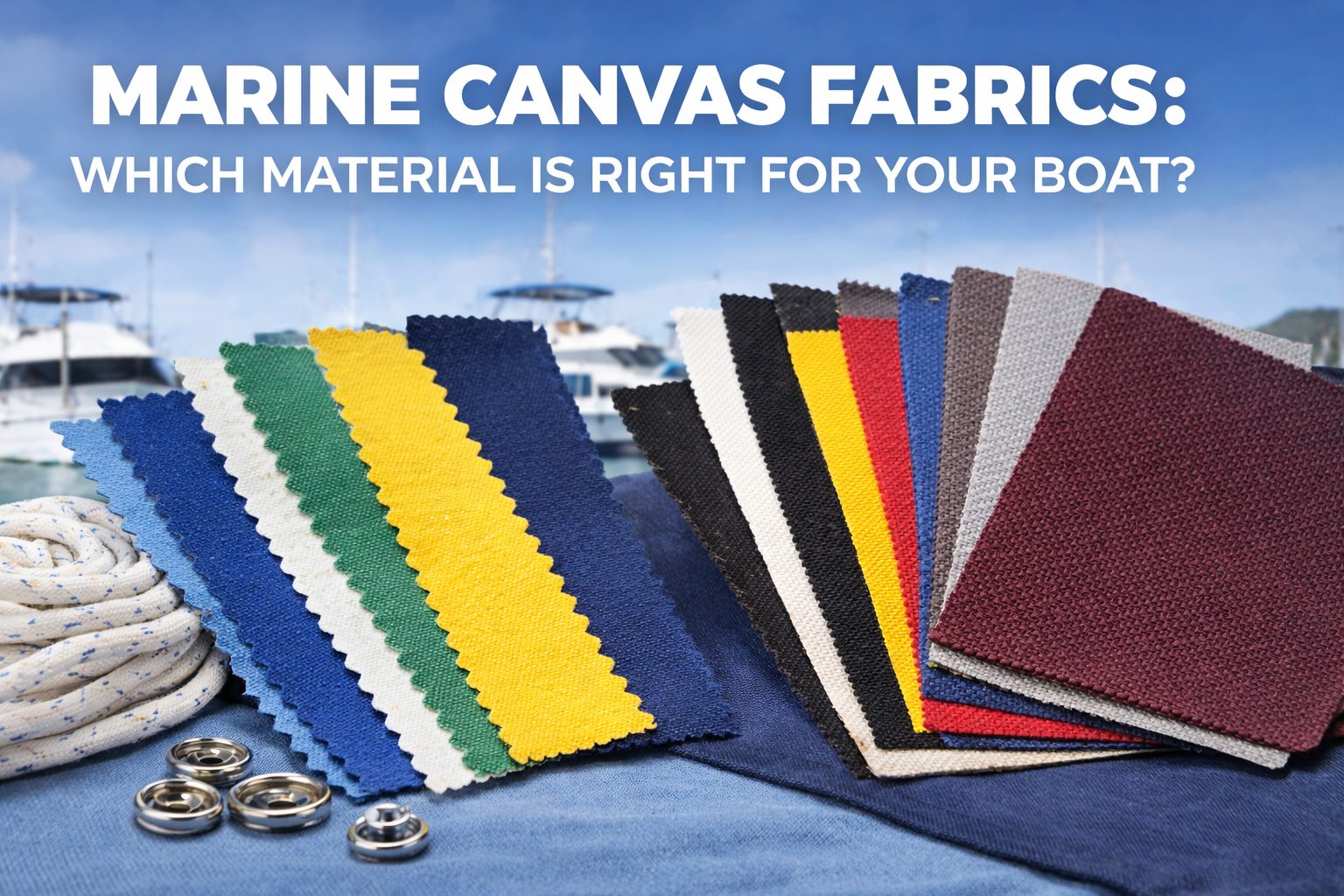
Choosing the right fabric for your sprayhood, bimini, or boat cover matters. The wrong choice could mean fading, leaking, or replacing the whole thing years earlier than you expected. The right choice means a product that looks great and performs for a decade or more.
There are two main types of fabric used in marine canvas: acrylic canvas and coated polyester. Each has its strengths. This guide cuts through the jargon and explains what you actually need to know.
Acrylic vs. Polyester: The Basics
Acrylic Canvas
Acrylic canvas is the traditional go-to for quality marine work. The colour is dyed into the fibre during manufacturing (called “solution dyeing”), which means it goes right through to the core – not just painted on the surface. The result? Exceptional fade resistance, even after years in direct sunlight.
Acrylic canvas has a natural, cloth-like feel. It breathes, which helps prevent condensation building up underneath. It can be supplied uncoated (with a water-repellent treatment) or with a polyurethane (PU) coating on the back for better waterproofing.
Coated Polyester
Polyester fabrics are inherently stronger and more abrasion-resistant than acrylics. They hold their shape well and resist stretching. The trade-off? Polyester doesn’t match acrylic for UV resistance on its own, so manufacturers add coatings and specialised dye processes to compensate.
Coated polyesters are generally tougher and more waterproof, but less breathable. They work well for protective covers and applications where strength matters more than ventilation.
Sauleda Acrylic Canvas
Sauleda is a Spanish manufacturer with over 125 years of experience producing technical fabrics. Their acrylic canvas is the most widely used marine canvas in the UK market and is the fabric you’ll find on the majority of sprayhoods, biminis, and enclosures across the Solent and south coast.
Sauleda Uncoated
The uncoated version has a fluorocarbon (Teflon) treatment that makes it water-resistant while keeping it breathable. Water resistance is rated at around 350 mm water column – enough to shed light rain, but not designed for prolonged heavy downpours.
Best for: Sail covers, wheel covers, hatch covers, and any application where breathability matters.
Sauleda PU Coated
The PU-coated version uses the same base cloth with a polyurethane coating on the underside. This pushes water resistance up to 800–1,000+ mm water column – a significant step up. It’s less breathable as a result, but for sprayhoods and enclosures that’s usually the right trade-off.
This is the most popular marine canvas finish in the UK. If your canvas shop doesn’t specify which fabric they use, there’s a good chance it’s Sauleda PU coated.
Best for: Sprayhoods, biminis, cockpit enclosures, and tonneau covers.
Both versions share these features:
- 300 gsm base cloth (330 gsm with PU coating), 150 cm wide
- Solution-dyed for outstanding UV and colour stability
- Treated with Sauleda Fabric Protector against mould and mildew
- 5-year manufacturer warranty
Pros:
- Excellent UV resistance – colours stay true for years
- Strong UK supply chain with reliable availability
- Cost-effective compared to Sunbrella
- European manufacture means shorter lead times for UK businesses
- Natural, traditional canvas appearance
Cons:
- Less abrasion-resistant than polyester fabrics
- Can stretch over time, particularly with larger panels
- Narrower colour range than some alternatives
- Can feel stiff when new (softens with use)
Sunbrella Plus
Sunbrella is the global name in marine canvas, made by US manufacturer Glen Raven. While various Sunbrella products exist, Sunbrella Plus is the most relevant for UK marine canvas work. It’s a 100% solution-dyed acrylic with a polyurethane coating on the underside – essentially the same concept as Sauleda PU Coated, but from a different manufacturer.
Sunbrella Plus weighs approximately 340 gsm and is available in 152 cm widths. It carries a 5-year limited warranty on the coated version.
Pros:
- Strong global brand recognition – some boat owners specifically ask for Sunbrella
- Excellent UV and fade resistance
- Large colour range
- Bleach-cleanable without damage
Cons:
- Significantly more expensive than Sauleda for very similar performance
- US manufactured – lead times and supply can be less reliable in the UK
- Lower abrasion resistance than polyester alternatives (same as all acrylics)
- Brand premium doesn’t always translate to noticeably better on-the-water performance
WeatherMAX (by Safety Components)
WeatherMAX takes a different approach. Originally developed for the US military, it uses a proprietary polyester yarn (SaturaMax) with a unique water-repellent finish called HydroMax+. This is not a traditional coating – it’s impregnated into the fabric, so it stays breathable while still shedding water effectively.
WeatherMAX 80
The standard version. At just 8 oz per square yard (around 270 gsm), it’s noticeably lighter than acrylic canvas but has roughly twice the tensile strength and six times better abrasion resistance. It also has near-equal strength in both warp and weft directions, which means if it does tear, the tear is less likely to keep running.
Best for: Boat covers, biminis, awnings, and winter storage covers.
WeatherMAX LT
A lighter-weight version (around 220 gsm) with the same technology. Soft and non-abrasive, making it particularly good for applications where the fabric sits against other surfaces.
Best for: Sail UV strips, boom covers, and lightweight protective covers.
Pros:
- Very strong and lightweight – easier to handle on larger covers
- Excellent dimensional stability – won’t sag or stretch like acrylic can
- Breathable without a traditional coating
- Good fade resistance
Cons:
- Different hand feel – more membrane-like, less “canvas-y”
- Less familiar to many UK boat owners
- Limited colour range
- 5-year warranty (vs. Sunbrella’s 10 years on uncoated Marine Grade)
Marlen Textiles: Top Notch, Top Gun & Odyssey
Marlen Textiles produces three polyester fabric ranges at different price and performance levels:
Top Notch – Premium
100% solution-dyed polyester (840 denier), 11.5 oz/sq yd. Uncoated, breathable, and reversible – the closest polyester gets to feeling like acrylic canvas. Superb strength and abrasion resistance. A genuine premium alternative to acrylic for applications where toughness matters most.
Top Gun – Mid-Range
Acrylic-coated polyester (600 denier), 11.5 oz/sq yd. Coated on both sides, making it reversible and highly water-resistant. The coating won’t crack or peel. Not breathable, so best suited to protective covers rather than enclosures. Top Gun 1S (one-side coated) is a good choice for boat covers as it avoids colour rub-off on gel coat.
Odyssey – Economy
Acrylic-coated polyester (300 denier), 6.5 oz/sq yd. A lightweight, budget-friendly option for shorter-term or less-exposed applications. Not in the same league as the above fabrics for longevity, but good value when cost is the primary driver.
Marlen range – Pros:
- Superior strength and abrasion resistance across all three ranges
- Excellent dimensional stability
- Range covers budget to premium
- 5-year warranty, 5–10 year life expectancy
Marlen range – Cons:
- UV resistance not as long-lasting as premium acrylics in constant sun exposure
- Coated versions (Top Gun, Odyssey) are not breathable
- Smaller colour palettes (12–20 colours per range)
- US manufactured – UK availability can vary
What Does It Actually Cost?
Fabric cost varies, but here’s a realistic comparison based on current UK pricing (March 2026, including VAT). These figures are per square metre so you can compare like-for-like regardless of different roll widths.
Prices based on current UK pricing, March 2026, including VAT. Sorted lowest to highest.
A few things to note:
- Sauleda PU Coated is remarkably good value at under £17/m² – less than two-thirds the cost of Sunbrella Plus for very similar performance.
- Sunbrella Plus costs over 50% more per m² than Sauleda PU Coated. The Sunbrella name carries a premium that’s hard to justify on performance alone.
- Top Notch is the most expensive option, but you’re paying for genuinely superior strength and abrasion resistance.
- Odyssey is the cheapest, but it’s a lighter-weight economy fabric – fine for short-term or less-exposed uses, not a like-for-like comparison with the others.
Remember: fabric typically accounts for a relatively small proportion of the total cost of a bespoke sprayhood or bimini. The difference between the cheapest and most expensive fabric on a typical project might be £100–£200. On a product that will be on your boat for 8–12 years, it makes sense to choose the right fabric for the job rather than the cheapest option.
Which Fabric for Which Job?
Needs enhanced water resistance and UV durability. PU-coated acrylics deliver both.
Primary need is UV protection. Both acrylics and premium polyesters work well here.
Reliable water resistance is essential. PU-coated acrylic balances waterproofing with some breathability.
Breathability prevents trapped moisture damaging sails. WeatherMAX LT is also soft and non-abrasive.
Maximum water resistance plus durability for handling. Top Gun 1S avoids colour transfer onto gel coat.
Needs strength for snow loads and breathability to prevent condensation during extended storage.
Lightweight, UV-resistant, and the filament polyester yarns resist fraying from abrasion better than acrylic.
Head-to-Head: Sauleda PU Coated vs. Top Notch
These two are worth comparing directly because they represent the best of each fabric family – a PU-coated acrylic versus a premium solution-dyed polyester.
Solution-dyed acrylic
330 gsm
High – 800–1,000+ mm (PU barrier)
Reduced (PU coating limits airflow)
Excellent – acrylic is the gold standard
Moderate – acrylic is softer
Can stretch over time
5 years
Solution-dyed polyester (840 denier)
390 gsm (11.5 oz/yd²)
Moderate – repellent finish, no coating
Good (no coating to block air)
Very good – but acrylic has the edge
Superior – polyester is tougher
Excellent – holds shape well
5 years
The bottom line: For sun-exposed applications like sprayhoods and biminis, where UV resistance and a traditional canvas look matter most, Sauleda PU Coated is the stronger choice – and at around 40% less cost per m². For covers that take a lot of physical handling, trailering, or abrasion, Top Notch offers real advantages in durability.
Our Approach at Trident Canvas
There’s no single “best” marine canvas fabric. The right choice depends on your boat, your sailing environment, and what the fabric needs to do.
For most bespoke sprayhoods, biminis, and cockpit enclosures on Solent yachts, we work with premium acrylic canvas. The combination of outstanding UV resistance, proven longevity in the UK climate, and the classic canvas look that discerning boat owners expect makes it the natural first choice.
But we’re always happy to discuss alternatives. If you need maximum toughness on a travel cover, or a lightweight option for sail protection, a premium polyester may be the better fit. What we won’t do is cut corners on materials. Every fabric we use is marine-grade, from a reputable manufacturer, and specified for the job.
Got a question about which fabric is right for your project? Get in touch – we’re always happy to talk it through.
Leave a Reply